Bringing the Mercy of Śrīmad-Bhāgavatam to Every Home!
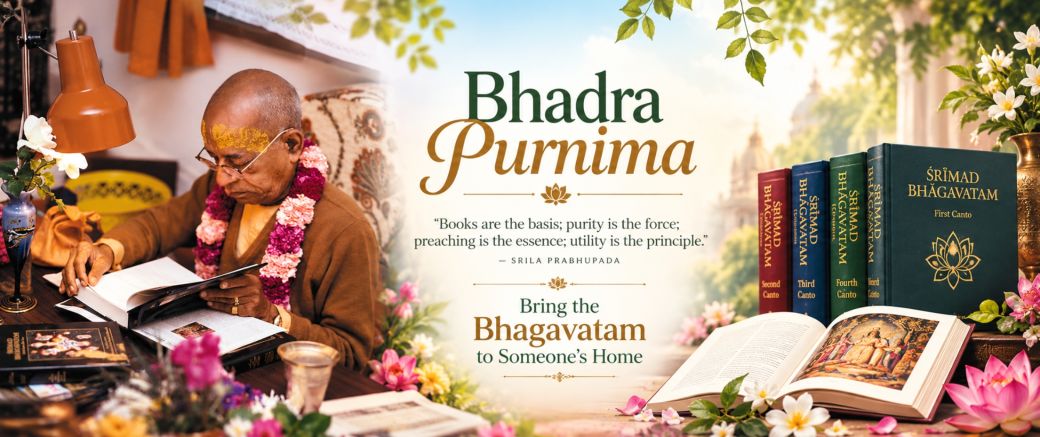
In Māyāpur, Bhadra Purnima is not simply a single day of celebration or a festival that begins on the day itself. The preparations create an opportunity to gradually enter the mood of the occasion—to hear, become inspired, and prepare our hearts to carry the mercy and message of Śrīmad-Bhāgavatam into many homes.
This period of preparation also brings together several significant occasions connected with great devotees and the spreading of Kṛṣṇa consciousness.
Viśvarūpa Mahotsava
Viśvarūpa Mahotsava commemorates the day when Viśvarūpa, the elder brother of Lord Śrī Caitanya Mahāprabhu, accepted the renounced order of life.
We hear from Śrī Caitanya-caritāmṛta:
After this, Jagannātha Miśra got a son of the name Viśvarūpa, who was most powerful and highly qualified because He was an incarnation of Baladeva.
Viśvarūpa was the elder brother of Gaurahari, Lord Śrī Caitanya Mahāprabhu. When arrangements were being made for the marriage of Viśvarūpa, He took sannyāsa and left home. He took the sannyāsa name of Śaṅkarāraṇya. In 1431 Śakābda Era (A.D. 1509), He disappeared in Pāṇḍarapura, in the district of Sholapur. As an incarnation of Saṅkarṣaṇa, He is both the ingredient and immediate cause of the creation of this material world. He is nondifferent from Śrī Caitanya Mahāprabhu, for the aṁśa and the aṁśī, or the part and the whole, are not different. As an incarnation of Saṅkarṣaṇa, Viśvarūpa belongs to the quadruple manifestation of catur-vyūha. In the Gaura-candrodaya it is said that Viśvarūpa, after His so-called demise, remained mixed within Śrī Nityānanda Prabhu.
— Caitanya-caritāmṛta, Ādi-līlā 13.74
The remembrance of Viśvarūpa's renunciation naturally brings our attention toward the importance of carrying forward the spiritual message received through our disciplic succession.
Bhadra Purnima and the Service of Śrīmad-Bhāgavatam
Bhadra Purnima is a particularly auspicious occasion for serving Śrīmad-Bhāgavatam. The Bhāgavatam itself declares:
“If on the full moon day of the month of Bhādra one places Śrīmad-Bhāgavatam on a golden throne and gives it as a gift, he will attain the supreme transcendental destination.”
— Śrīmad-Bhāgavatam 12.13.13
The Varāha Purāṇa similarly describes the special nature of celebrating the appearance of Śrīmad-Bhāgavatam:
Sri Narayana said to Brahma, O saintly brahmana! among all of my festivals, the celebration of the appearance of Srimad Bhagavatam is the best. I am subdued by persons who with devotion and love hear, decorate and worship Srimad Bhagavatam, with clothes, ornaments, flowers, incense and lamp during festivals, just as a chaste wife subdues her husband.
For this reason, Bhadra Purnima gives us a beautiful opportunity to consider how we can serve Śrīmad-Bhāgavatam.
We can gift a copy of Śrīmad-Bhāgavatam to someone close to us. We can bring Śrīmad-Bhāgavatam into our own home. We can begin reading it, or make a simple commitment to read at least one verse from Śrīmad-Bhāgavatam every day.
There are many ways to serve the lotus feet of Śrīmad-Bhāgavatam and to participate in the benediction Kṛṣṇa has kindly made available to us.
Śrīla Sanātana Gosvāmī offers this beautiful prayer to Śrīmad-Bhāgavatam:
O Śrīmad-Bhāgavatam, I offer respectful obeisances unto You. By reading you one attains transcendental bliss, for Your syllables rain pure love of God upon the reader. You are always to be served by everyone, for you are an incarnation of Krishna.
O Śrīmad-Bhāgavatam, O my only friend, O my companion, O my teacher, O my great wealth, O my deliverer, O my good fortune, O my bliss, I offer respectful obeisances unto you.
O Śrīmad-Bhāgavatam, O giver of saintliness to the unsaintly, O uplifter of the very fallen, please do not ever leave me. Please become manifested upon my heart and my throat, accompanied by pure love of Krishna.
— Kṛṣṇa-līlā-stava, verses 414–416
Śrīla Prabhupāda and the Mission of Śrīmad-Bhāgavatam
As we prepare for Bhadra Purnima, we also remember Śrīla Prabhupāda's acceptance of the renounced order of life.
Śrīla Prabhupāda accepted sannyāsa from Śrī Śrīmad Bhaktiprajñāna Keśava Mahārāja on September 17, 1959, at Keśavajī Maṭha in Mathura.
Looking back on the circumstances surrounding his acceptance of sannyāsa, Śrīla Prabhupāda said:
“I was sitting alone in Vṛndāvana, writing. My Godbrother insisted to me, ‘Bhaktivedanta Prabhu, you must do it. Without accepting the renounced order of life, nobody can become a preacher.’ So he insisted. Not he insisted; practically my spiritual master insisted. He wanted me to become a preacher, so he forced me through this Godbrother: ‘You accept.’ So, unwillingly I accepted.”
— Śrīla Prabhupāda-līlāmṛta, Vol. 1, Chapter 9
At the sannyāsa ceremony, Abhay sat beside the elderly Sanātana and received the traditional sannyāsa-danda, saffron garments, tulasī neck beads and the sannyāsa-mantra. Keśava Mahārāja announced that Abhay would now be known as Bhaktivedanta Swami Mahārāja.
Although he had already given up family, home comforts and business years earlier, accepting sannyāsa carried a deeper significance. It represented the mandate he had required and the irrevocable commitment to preach.
It was now only a matter of time before Bhaktivedanta Swami would travel to the West, carrying out the desire of his spiritual master, Śrīla Bhaktisiddhānta Sarasvatī Ṭhākura.
When asked, “Are you going to America?”, Śrīla Prabhupāda replied:
“No, Śrīmad-Bhāgavatam is going to America—I am going with it.”
This statement beautifully captures the mood of the days leading up to Bhadra Purnima. Śrīla Prabhupāda did not simply travel to the West; he carried Śrīmad-Bhāgavatam with him. Through his dedication, its message reached homes and hearts around the world.
And we do not all have to become sannyāsīs to participate in this mission. Śrīla Prabhupāda explained:
“The Krishna consciousness movement is not that we are asking everyone to become a sannyāsī like me, and give up everything. No. That is not our program. You act as a brāhmaṇa, as a kṣatriya or a vaiśya or a śūdra. It doesn’t matter. But you try to satisfy Krishna. That is the program.”
— Śrīla Prabhupāda Lecture, Bombay, December 30, 1972
As the preparations for Bhadra Purnima continue in Māyāpur, we too can begin preparing—not simply for a festival, but for a mood of service.
The pandal has been set up. The yajña has been performed. The atmosphere is beginning to awaken.
Now we can prepare our own hearts.
We can hear Śrīmad-Bhāgavatam.
We can become inspired by its message.
We can bring it into our homes.
And we can help bring its mercy to someone else's home.
Bhadra Purnima is coming. Let us prepare not only to celebrate Śrīmad-Bhāgavatam, but to become instruments for sharing its message.
All glories to Viśvarūpa Mahotsava.
All glories to Bhadra Purnima.
All glories to Śrīmad-Bhāgavatam.
All glories to Śrīla Prabhupāda.
Posted 3 weeks ago