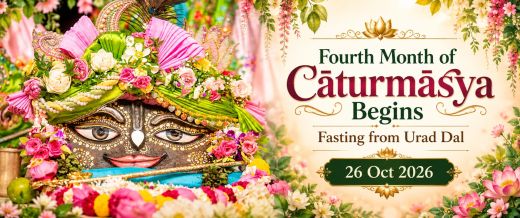
The sacred month of Kārtika, also known as Dāmodara Māsa, marks the beginning of the fourth and final month of Cāturmāsya. Beginning on 26 October 2026, this auspicious period invites devotees to deepen their devotion to Lord Śrī Kṛṣṇa through sincere prayer, spiritual discipline, and loving service.
Cāturmāsya is a sacred four-month period dedicated to cultivating self-control, simplifying our lives, and increasing our remembrance of the Supreme Lord. Śrīla Prabhupāda explains in his purport to Śrī Caitanya-caritāmṛta, Madhya-līlā 4.169, that the purpose of observing these vows is to reduce sense gratification and advance in devotional service.
This beautiful pastime reveals the extraordinary sweetness of the Lord. He is conquered not by wealth, scholarship, or strength, but by sincere love and devotion.
During this month, devotees lovingly worship Lord Dāmodara, offer ghee lamps, sing the Śrī Dāmodarāṣṭakam, chant the holy names, and hear the transcendental pastimes of the Lord. Even a simple offering, made with a sincere heart, becomes a beautiful expression of love for Kṛṣṇa.
These practices are not merely external austerities. Their true purpose is to purify the heart and awaken our natural love for the Lord. Every restraint becomes meaningful when undertaken for Kṛṣṇa’s pleasure, and every act of service becomes an opportunity to remember His boundless mercy.
As we enter this sacred month, let us renew our commitment to devotional life. Let our homes resound with the chanting of the Hare Kṛṣṇa mahā-mantra, let our hands offer lamps to Lord Dāmodara, and let our hearts become filled with gratitude for His causeless mercy.
May this auspicious month inspire us to move beyond the distractions of material life and take shelter in the loving service of Śrī Śrī Rādhā-Dāmodara.
This Kārtika, let us offer not only a lamp to the Lord, but also the light of our hearts in loving surrender at His lotus feet.
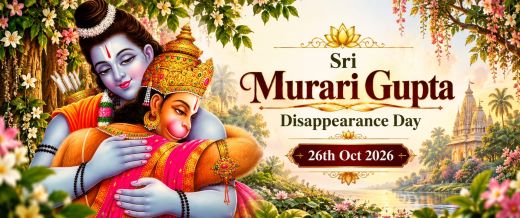
Among the intimate associates of Śrī Chaitanya Mahāprabhu, Śrī Murāri Gupta holds a special place as an embodiment of humility, compassion, and unwavering devotion. A physician by profession and a treasure house of love of God, he dedicated his life to serving the Lord and His devotees. In the Gauḍīya Vaiṣṇava tradition, he is revered as the incarnation of Śrī Hanumān, the eternal servant of Lord Śrī Rāmacandra.
According to Gaura-gaṇoddeśa-dīpikā (91):
murāri-gupto hanumān
aṅgadaḥ śrī-purandaraḥ
yaḥ śrī-sugrīva-nāmāsīd
govindānanda eva saḥ
This verse reveals that Murāri Gupta was Hanumān in Lord Rāmacandra’s pastimes, Purandara was Aṅgada, and Govindānanda was Sugrīva. Just as Hanumān’s heart was eternally absorbed in the service of Lord Rāma, Murāri Gupta’s life exemplified unshakable devotion to his beloved Lord.
Born into a family of Ayurvedic physicians in Śrīhaṭṭa (Sylhet), Murāri Gupta later moved to Navadvīpa, where he became a close companion of the young Nimāi Paṇḍita. They studied together under Gaṅgādāsa Paṇḍita, engaging in discussions and scholarly debates. Even during these childhood pastimes, Murāri Gupta witnessed Mahāprabhu’s extraordinary intelligence and spiritual potency. His very name carries a beautiful significance: gupta means “hidden,” indicating that Śrī Murāri, the Lord Himself, resided secretly within his heart.
Śrīla Kṛṣṇadāsa Kavirāja Gosvāmī glorifies him in Śrī Caitanya-caritāmṛta (Ādi-līlā 10.49), describing Murāri Gupta as the twenty-first branch of the tree of Śrī Chaitanya Mahāprabhu and a treasure house of love of Godhead, whose humility melted the Lord’s heart. His compassion extended beyond bodily healing. As a physician, he treated physical ailments, while his devotion and association helped others overcome the deeper disease of material existence. As stated in Śrī Caitanya-caritāmṛta (Ādi-līlā 10.51), he relieved both bodily and spiritual suffering.
One of the most celebrated episodes of his life reveals the depth of his devotion to Lord Rāmacandra. Mahāprabhu once encouraged him to worship Lord Śrī Kṛṣṇa. Although Murāri Gupta deeply respected the Lord’s instruction, he could not bear the thought of abandoning his beloved Rāma. Overwhelmed with anguish, he surrendered at Mahāprabhu’s lotus feet, expressing his inability to give up his eternal Lord. Mahāprabhu was profoundly pleased by this steadfastness and glorified his unflinching devotion. This beautiful pastime, described in Śrī Caitanya-caritāmṛta (Madhya-līlā 15.137–157), teaches that pure devotion is rooted in eternal, loving service to one’s worshipable Lord.
Murāri Gupta also made an invaluable contribution to the Gauḍīya Vaiṣṇava tradition by composing Śrī Kṛṣṇa-Caitanya-caritāmṛta, a Sanskrit account of Mahāprabhu’s life and pastimes. His writings preserve precious memories of the Lord’s early activities and remain an important source for understanding the history of the Gauḍīya Vaiṣṇava movement.
On the sacred occasion of his disappearance day, we remember Śrī Murāri Gupta’s humility, compassion, and unwavering love for Lord Rāmacandra. His life reminds us that genuine devotion is expressed through steadfast faith, selfless service, and complete surrender to the Lord.
May we pray for the mercy of Śrī Murāri Gupta, that our hearts may become filled with pure devotion and that, like Śrī Hanumān, we may dedicate every moment of our lives to the loving service of the Lord.
bhagavan api ta ratrih
saradotphulla-mallikah
viksy- a rantum manas cakre
yoga-mayam upasritah
Sri Kṛṣṇa is the Supreme Personality of Godhead, full in all opulences, yet upon seeing those autumn nights scented with blossoming jasmine flowers, He turned His mind toward loving affairs. To fulfill His purposes He employed His internal potency. — Śrīmad-Bhāgavatam 10.29.1
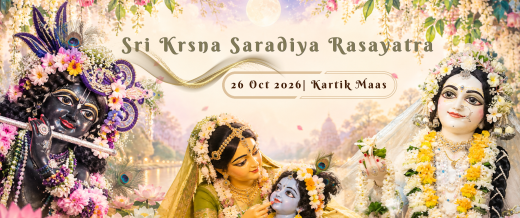
On the full moon night of Kārtika, the forests of Vṛndāvana are remembered as the setting for one of the most enchanting pastimes of Lord Śrī Kṛṣṇa: the Rāsa-līlā. Beneath the autumn moon, amid the fragrance of blossoming jasmine and the gentle sounds of the forest, Śyāmasundara plays His flute, awakening the hearts of His beloved gopīs and inviting them into His transcendental dance. This pastime reveals the extraordinary sweetness of the Lord and the loving exchanges He shares with His devotees.
In Śrīdhāma Māyāpur, which is deeply connected with the spiritual atmosphere of Vṛndāvana, Śrī Kṛṣṇa Rāsayātrā is celebrated with beautiful offerings and devotional festivities. On this auspicious occasion, the dancing Deities of Śrīmatī Rādhārāṇī and the Aṣṭa-sakhīs, each accompanied by their own Śrī Mādhava, are beautifully arranged on the platform below the altar of Śrī Śrī Rādhā-Mādhava. Devotees prepare sweet rice and a variety of milk sweets as offerings for Their Lordships, seeking to please Them on this sacred evening.
Rāsa Pūrṇimā also marks the beginning of Śrī Śrī Rādhā-Mādhava’s weekly elephant processions in Māyāpur. On this special evening, Their Lordships come out of the temple and travel around the Māyāpur campus on the back of an elephant, accompanied by Śrī Śrī Gaura-Nitāi from Śrīla Prabhupāda’s Bhajana-kuṭīra. A harināma party leads the procession with ecstatic kīrtana, filling the atmosphere with the chanting of the holy names.
As Their Lordships proceed through the campus, the sounds of conch shells and vibrant drums announce Their arrival. The boys of the Māyāpur Gurukula chant auspicious mantras, while the pathways glow with the light of lamps and the campus shines with festive illumination. Devotees create intricate raṅgolīs along the procession route, using colourful powders, flowers, and other natural materials to transform the surroundings into offerings of beauty and devotion. The community also prepares a variety of dishes for the pleasure of the Lord.
The evening continues with devotees offering lamps to Their Lordships, followed by the singing of Dāmodarāṣṭakam and the Gopī-gīta. Through these offerings, prayers, and the collective chanting of the holy names, the devotees express their desire to serve and please Śrī Śrī Rādhā-Mādhava.
The full moon of Dāmodara month is also known as the second full moon of the autumn season, when Rāsa-līlā is celebrated again. This second Rāsa-yātrā is observed especially in Bengal, while the first is celebrated more prominently in Śrīdhāma Vṛndāvana. In Māyāpur, the occasion brings together worship, music, dance, kīrtana, lamps, and beautiful offerings, allowing devotees to remember the transcendental pastimes of the Divine Couple.
As Śrīla Prabhupāda explains:
“By gradual development of transcendental knowledge, one can rise to the stage of the transcendental arts of music and dance displayed by the Lord in His rasa-lila. But without having the Vedic knowledge one can hardly understand the transcendental nature of the Lord's rasa dance and music.” — Śrīla Prabhupāda, Śrīmad-Bhāgavatam 2.2.4
The Rāsa-līlā is not an ordinary dance, but a transcendental pastime of the Supreme Lord, whose activities are understood through spiritual knowledge and devotion. By the mercy of Śrī Caitanya Mahāprabhu and Śrīla Prabhupāda, devotees are given the opportunity to hear about Kṛṣṇa’s pastimes in the proper devotional understanding and gradually appreciate their sweetness.
Ultimately, Śrī Kṛṣṇa Rāsayātrā is an opportunity to turn our hearts towards the pleasure of the Lord. Through the procession, kīrtana, lamp offerings, and loving service, the devotees seek not their own enjoyment, but the pleasure of Śrī Śrī Rādhā-Mādhava. This is the essence of the festival: to remember the Lord’s transcendental pastimes and engage whatever we have in His service.
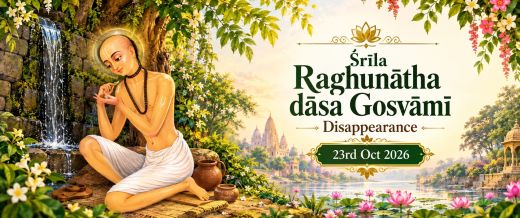
Among the great saints of the Gauḍīya Vaiṣṇava tradition, Śrīla Raghunātha Dāsa Gosvāmī shines as an extraordinary example of renunciation, humility, and unwavering love for Śrī Chaitanya Mahāprabhu. One of the Six Gosvāmīs of Vṛndāvana, he dedicated his entire life to the loving service of Śrī Śrī Rādhā-Kṛṣṇa.
Born into an immensely wealthy family in Bengal, Śrīla Raghunātha Dāsa Gosvāmī possessed everything the material world could offer. Yet his heart longed for something far greater—the mercy and association of Śrī Chaitanya Mahāprabhu. Despite repeated attempts by his family to keep him engaged in worldly life, his desire for spiritual service remained unshaken.
By the mercy of Śrī Nityānanda Prabhu, he eventually received the opportunity to leave home and join Mahāprabhu in Jagannātha Purī. There, under the guidance of Śrī Svarūpa Dāmodara Gosvāmī, he served the Lord with profound humility and devotion. Mahāprabhu personally entrusted him with a Govardhana-śilā and a garland of guñjā beads, sacred gifts that deepened his remembrance of the Divine Couple.
After Mahāprabhu’s disappearance, Śrīla Raghunātha Dāsa Gosvāmī went to Vṛndāvana and eventually settled at the sacred banks of Rādhā-kuṇḍa. His life became a remarkable example of intense bhajana, constant chanting of the holy names, and deep absorption in the service of Śrīmatī Rādhārāṇī.
His profound devotional writings, including Vilāpa-kusumāñjali and Manaḥ-śikṣā, reveal the heart of a devotee longing for the mercy and loving service of Rādhārāṇī. He is revered as the prayojana-ācārya, one who teaches the ultimate goal of spiritual life: pure love of God.
Śrīla Raghunātha Dāsa Gosvāmī’s life reminds us that true wealth lies not in material possessions, but in a heart wholly surrendered to the Lord. His example continues to inspire devotees to cultivate humility, deepen their chanting, and aspire for the selfless service of Śrī Śrī Rādhā-Kṛṣṇa.
May we pray for his mercy, that we too may develop a sincere longing to serve the Lord and follow the path of pure devotion shown by the great Vaiṣṇava ācāryas.